How is shipbuilding steel plate manufactured?
As a dedicated supplier of shipbuilding steel plates, I’ve witnessed firsthand the incredible journey these essential components undertake from raw materials to the decks and hulls of majestic vessels. The process of manufacturing shipbuilding steel plates is a complex and精密的 endeavor that combines advanced technology, strict quality control, and a deep understanding of naval architecture. Shipbuilding Steel Plate

Step 1: Raw Material Selection
The foundation of any high – quality shipbuilding steel plate lies in the careful selection of raw materials. We source high – grade iron ore, which is rich in iron content and has low levels of impurities such as sulfur and phosphorus. These impurities can significantly weaken the steel, so we work with trusted mines that adhere to strict quality standards.
In addition to iron ore, we also use other alloying elements like manganese, chromium, nickel, and molybdenum. These elements are added in specific quantities to enhance the steel’s strength, toughness, and corrosion resistance. For example, manganese improves the hardenability of the steel, while chromium helps form a protective oxide layer on the surface, preventing rust.
Step 2: Ironmaking
Once the raw materials are selected, the first major step is ironmaking. The iron ore is first crushed and then mixed with coke (a form of carbon) and limestone in a blast furnace. The blast furnace is a massive structure where intense heat is generated by burning coke.
The high temperature causes a series of chemical reactions. The coke reacts with oxygen to produce carbon monoxide, which then reduces the iron oxide in the ore to metallic iron. The limestone acts as a flux, combining with impurities in the ore to form slag, which floats on top of the molten iron. The molten iron, known as pig iron, is then tapped from the bottom of the blast furnace. Pig iron contains a relatively high amount of carbon (about 3 – 4%) and other impurities, so it needs further refinement to become suitable for shipbuilding.
Step 3: Steelmaking
There are two main methods of steelmaking: the basic oxygen furnace (BOF) process and the electric arc furnace (EAF) process. At our facilities, we primarily use the BOF process for large – scale production.
In the BOF process, the pig iron is transferred to a converter, where pure oxygen is blown through the molten metal at high speeds. The oxygen reacts with the carbon and other impurities in the pig iron, burning them off and reducing the carbon content to the desired level for shipbuilding steel (usually around 0.1 – 0.25%). This process is very efficient and can produce large quantities of steel in a relatively short time.
The EAF process, on the other hand, uses electric arcs to melt recycled steel scrap and sometimes some new iron sources. This method is more environmentally friendly as it reduces the need for virgin iron ore and energy consumption. We also use the EAF process for producing specialized steel grades with specific alloy compositions.
After the steel is made, it undergoes secondary refining processes. These include ladle metallurgy, where the steel is further treated in a ladle to adjust its chemical composition, temperature, and remove any remaining impurities. This ensures that the steel meets the strict standards required for shipbuilding.
Step 4: Continuous Casting
Once the steel has the correct chemical composition and temperature, it is ready for continuous casting. In this process, the molten steel is poured from a ladle into a water – cooled copper mold. As the steel enters the mold, it begins to solidify on the outer surface, forming a thin shell.
The partially solidified steel is then continuously withdrawn from the bottom of the mold at a controlled speed. As it moves along a series of rollers, it continues to cool and solidify completely. The result is a semi – finished product called a slab, which has a rectangular cross – section and is typically several meters long. Continuous casting is a more efficient and cost – effective method compared to traditional ingot casting, as it reduces waste and improves the quality of the steel.
Step 5: Rolling
The slabs are then transported to the rolling mill for further processing. The rolling process is crucial for shaping the slabs into shipbuilding steel plates of the required thickness and dimensions.
The slabs are first reheated in a furnace to a high temperature (usually around 1200 – 1300°C) to make them more malleable. They are then passed through a series of rolling stands, where large rollers apply pressure to the slabs, reducing their thickness and increasing their length and width.
There are two main types of rolling: hot rolling and cold rolling. For shipbuilding steel plates, we mainly use hot rolling because it allows for greater deformation of the steel and produces plates with excellent mechanical properties. During hot rolling, the steel is plastically deformed at high temperatures, which refines the grain structure of the steel, improving its strength and toughness.
After hot rolling, the steel plates may be subjected to a process called controlled cooling. This involves cooling the plates at a specific rate to achieve the desired microstructure and mechanical properties. Some plates may also be tempered to relieve internal stresses and further enhance their toughness.
Step 6: Heat Treatment
In some cases, shipbuilding steel plates may require additional heat treatment to meet specific performance requirements. Heat treatment involves heating the plates to a precise temperature and then cooling them at a controlled rate.
One common heat treatment process is normalizing. In normalizing, the steel plates are heated to a temperature above the critical range and then cooled in still air. This process refines the grain structure of the steel, improves its strength and toughness, and reduces any internal stresses.
Another important heat treatment is quenching and tempering. Quenching involves rapidly cooling the steel plates from a high temperature, usually by immersing them in water or oil. This produces a very hard and brittle structure. Then, the plates are tempered by reheating them to a lower temperature to relieve the internal stresses and improve their toughness. Quenched and tempered steel plates are often used in high – stress areas of ships, such as the hull and the decks.
Step 7: Quality Control
Quality control is an integral part of the manufacturing process for shipbuilding steel plates. We have a comprehensive quality control system in place that begins with the raw materials and continues throughout the entire manufacturing process.
At the raw material stage, we conduct chemical analysis to ensure that the iron ore and alloying elements meet our specified requirements. During steelmaking, we continuously monitor the chemical composition, temperature, and other parameters to ensure consistent quality.
After rolling and heat treatment, the steel plates are subjected to a series of tests. These include non – destructive testing methods such as ultrasonic testing, magnetic particle testing, and radiographic testing to detect any internal and surface defects. Mechanical testing is also carried out to determine the tensile strength, yield strength, elongation, and impact toughness of the plates. Only plates that pass all these tests are approved for shipment.
Step 8: Surface Treatment
Before the steel plates are ready for the shipbuilding yard, they usually undergo surface treatment to protect them from corrosion during storage and transportation. The most common surface treatment method is painting.
We use high – quality anti – corrosion paints that are specifically designed for shipbuilding applications. The plates are first cleaned to remove any rust, scale, and dirt. Then, a primer is applied, followed by one or more coats of topcoat. The paint system provides a barrier between the steel and the surrounding environment, preventing moisture and oxygen from reaching the steel surface and causing corrosion.
Conclusion
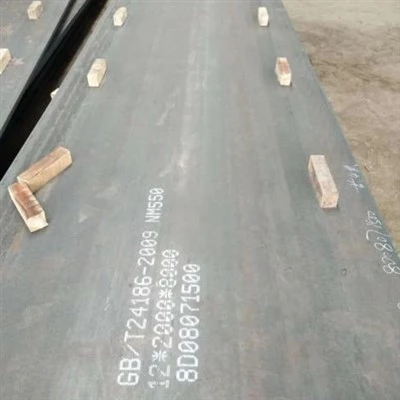
The manufacturing process of shipbuilding steel plates is a highly complex and sophisticated operation that requires a deep understanding of metallurgy, advanced technology, and strict quality control. At our company, we are committed to producing the highest quality shipbuilding steel plates that meet the stringent requirements of the marine industry.
ASTM/ASME HSLA Steel Plate If you are in the shipbuilding business and are in need of high – quality steel plates, we encourage you to reach out to us to discuss your requirements. Our team of experts is ready to provide you with detailed information and support to help you make the best choice for your projects. We look forward to working with you to contribute to the construction of safe and reliable ships.
References
- ASM Handbook, Vol. 1: Properties and Selection: Irons, Steels, and High – Performance Alloys, ASM International.
- Shipbuilding Steel: Specifications and Standards, Classification Societies Publications.
- Principles of Steelmaking and Rolling, Textbooks on Metallurgical Engineering.
Gnee Steel (Tianjin) Co., Ltd.
As one of the most professional shipbuilding steel plate manufacturers and suppliers in China, we also support customized service with low price. We warmly welcome you to buy high quality shipbuilding steel plate in stock here from our factory. If you have any enquiry about free sample, please feel free to email us.
Address: No.4-1114, Beichen Building, Beicang Town, Beichen District, Tianjin, China
E-mail: alloy@gneesteelgroup.com
WebSite: https://www.chinavesselplates.com/
